Job Site Generators
- sales188725
- May 23
- 3 min read
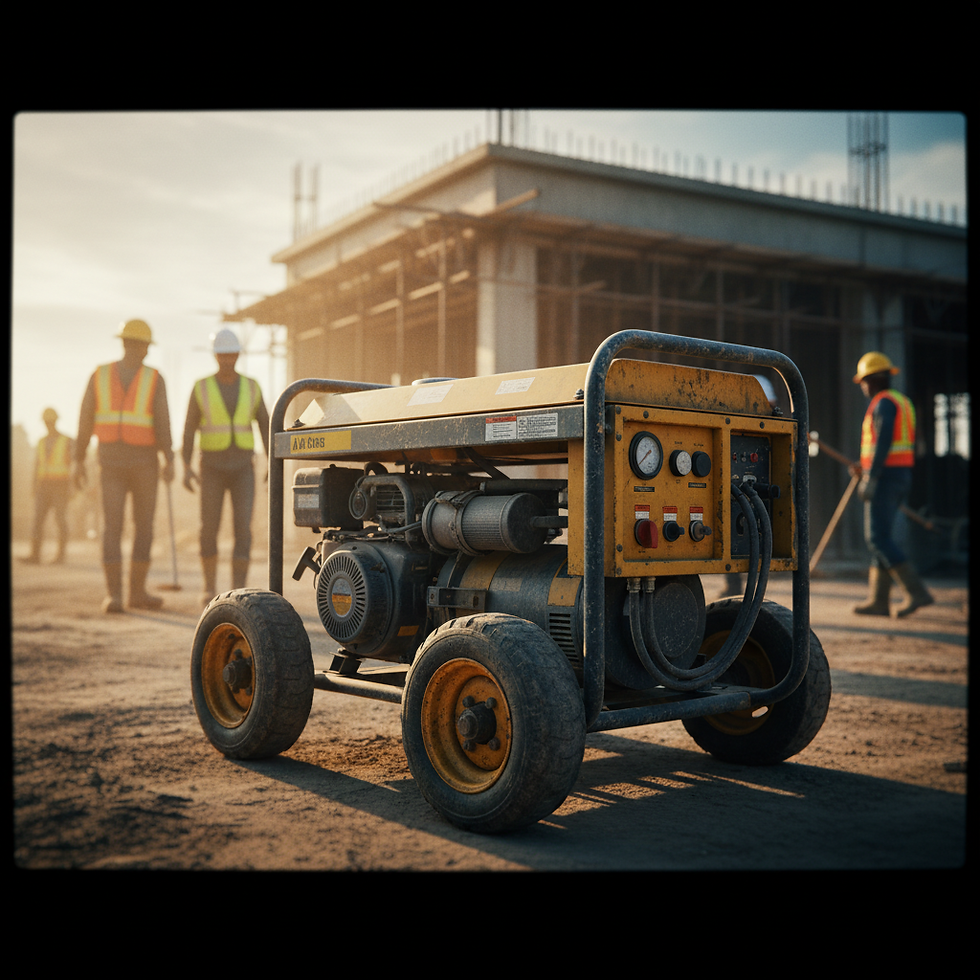
Choosing the right generator for a job site isn't just about raw power. You need reliability under heavy loads, OSHA-compliant safety features, and enough runtime to get through a full shift without constant refueling. Here are the top portable generators worth considering in 2024.
Top Picks at a Glance
Generator | Running Watts | Runtime (50% load) | Best For |
|---|---|---|---|
Honda EB10000 | 9,000 W | 7.9 hrs | Heavy-duty commercial sites |
DeWalt DXGNR8000 | 8,000 W | 11 hrs | General construction crews |
Generac GP8000E | 8,000 W | 11 hrs | High-value output |
Champion 8500 Dual-Fuel | 7,500 W | 10.5 hrs | Fuel flexibility |
Honda EU7000iS | 5,500 W | 18 hrs (25% load) | Noise-sensitive sites |
Honda EU2200i | 1,800 W | 8+ hrs | Light tools and electronics |
The Best Heavy-Duty Pick: Honda EB10000
The Honda EB10000 is the benchmark for commercial job sites. Its GX630 engine delivers 9,000 running watts and 10,000 starting watts, enough to power multiple large tools at once. Full GFCI protection on every outlet makes it OSHA-compliant out of the box, and the 7.9-hour runtime at half-load means fewer refueling stops per shift. It's one of the most reliable platforms in its class, though the price reflects that.
Best for General Construction: DeWalt DXGNR8000
The DeWalt DXGNR8000 is built to take abuse. A rugged steel tube cradle protects the internals on rough terrain, and the Smart Runtime Meter estimates remaining hours based on current fuel and load, so there are no surprise shutdowns mid-job. At 8,000 running watts and an 11-hour runtime at 50% load, it comfortably handles saws, compressors, and lighting simultaneously. Idle control kicks in during tool downtime to stretch fuel further.
Best High-Value Output: Generac GP8000E
Generac's PowerRush technology gives the GP8000E a 30% boost in starting capacity over its rated watts, which matters when you're firing up motors on air compressors or large saws. The built-in COsense sensor automatically shuts the unit down if carbon monoxide levels rise, a critical safety feature on enclosed or semi-enclosed sites. A plug-in battery jack keeps the electric start battery topped up, so it's ready every morning without fuss.
Best Dual-Fuel Option: Champion 8500-Watt
When gasoline is scarce or propane is more convenient on a remote site, the Champion 8500 dual-fuel generator switches between both with a simple valve. CO Shield technology adds an automatic carbon monoxide shutoff, and Volt Guard protects sensitive tools from power surges. At 7,500 running watts on gas and a 10.5-hour runtime, it covers most mid-size crew needs without locking you into one fuel type.
Best for Noise-Sensitive Sites: Honda EU7000iS
Residential renovation, hospital construction, or any site near occupied buildings requires a quieter solution. The EU7000iS runs at 52–58 dBA, about as loud as a normal conversation. Its fuel-injected GX390 engine needs no choke and delivers clean power with less than 3% total harmonic distortion, safe for computers, chargers, and other sensitive electronics. At 18 hours of runtime at 25% load, it's also the most fuel-efficient option in this list. The trade-off is weight: at 263 lbs, you'll want a site vehicle or crane lift to move it.
Best Compact Pick: Honda EU2200i
At just 47.4 lbs, the EU2200i is the generator one person can actually carry. It puts out 1,800 running watts, enough for light power tools, site lighting, phone chargers, and laptops. It runs at 57 dB and costs a fraction of the larger models. It won't power a compressor or a table saw, but as a secondary unit for charging stations or a small trailer office, it's hard to beat.
What to Look for Before You Buy
Power Output
Add up the wattage of every tool you plan to run at once, then add 20% for motor startup surges. That's your minimum running watt requirement.
OSHA Compliance
Any generator used on a job site must have GFCI-protected outlets on all 125V receptacles. Check the spec sheet before purchasing.
CO Safety
Always run generators outdoors and at least 20 feet from any opening. Prefer models with automatic CO shutoff for an extra layer of protection.
Runtime and Tank Size
A larger fuel tank means fewer interruptions. Look for at least 8 hours of runtime at 50% load to cover a standard shift.
Portability
Never-flat wheels and a solid frame matter when you're moving a 200+ lb unit across a muddy or uneven site every day.
Fuel Type
Dual-fuel models give you flexibility when one fuel is hard to source. Tri-fuel units (gas, propane, natural gas) are worth the premium on long-term or remote projects.
For most crews, the DeWalt DXGNR8000 or Generac GP8000E hit the best balance of output, runtime, and value. If budget isn't the primary concern and long-term reliability is, Honda's commercial EB series is the professional standard for a reason.


Comments